


Phase One Reaching Out to the Community Creating a Base of Interested Families
To make this work you’ll need to connect with dozens, if not hundreds, of individuals in your community to form a base of interested families. You can start by forming a core group of parents you know and trust. These are parents who will take part in your shared vision even if they do not have children who will benefit from this initiative. If you are not initiating this endeavor with a target language already in mind, but are interested in dual-language education as a way to educate your child, it is preferable to research your community’s linguistic heritage in order to gauge the support you might receive. Understanding the cultural nuances upon which a specific community will judge your proposal will be key, and identifying partners and fellow educational entrepreneurs from within the target culture will help to facilitate your project by presenting it in a way that is typically acceptable or preferred by a community.
Ways to Reach Out and Find Interested Families
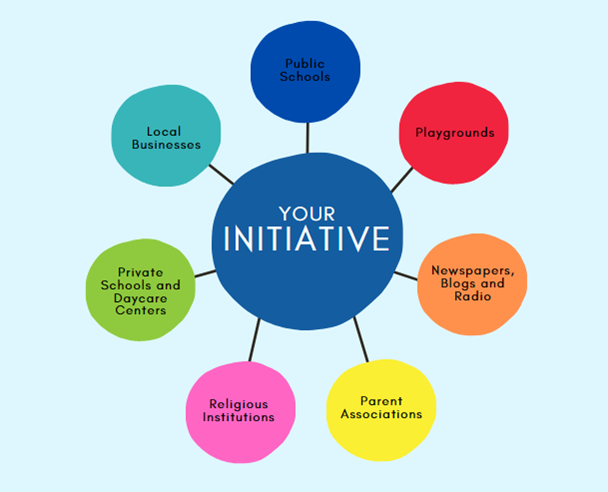
- Make a public announcement through social media, community and parenting blogs, letters, flyers, posters, or word of mouth that you are looking for people who are interested in helping you to create a dual-language program in a specific language.
- Look for existing community networks of businesses, religious centers, community centers, and children who are native speakers of another language within the parameters of your school district.
- Distribute a letter or flyer when you attend meetings or give presentations.
- Contact local preschools and daycare centers, Head-Start programs, private schools, language schools, cultural centers, religious institutions, parent associations, and city agencies that support families.
- Engage in conversations with parents at local playgrounds, in stores, at supermarkets, and in schools where families might be looking for options for younger siblings.
- Wear clothes, hats, or badges that will pique other parents’ curiosity.
Once your group has gathered enough volunteers, you can start organizing committees to divide up the various tasks. Several committees can be organized, including: a community outreach committee, a school location committee, and a curriculum support committee. Additional committees can also be included at various stages of the process based on the initiative’s more urgent needs, such as a teacher recruitment committee, a fundraising committee, or an after-school program committee, to name a few.


Collecting Data
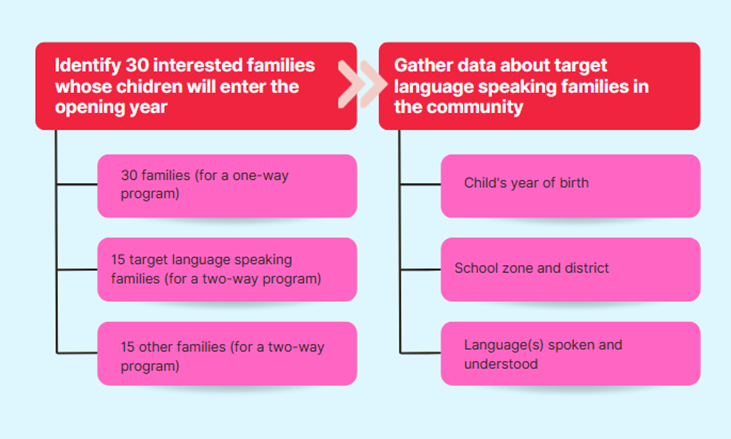
Your community outreach committee should focus on gathering family data on:
- The number of families potentially interested in the program,
- The languages spoken at home and understood by the children,
- Children’s dates of birth and their anticipated entry into primary school,
- Families’ school district or school zone
This data collection will also help you determine whether the dual-language program that you will be supporting will be one-way or two-way:
- One-way: with only one group of children speaking the same language and receiving instruction in another.
- Two-way: with two groups of children split into one group whose home language is the program’s target language and another group whose language is the official or national language, in this case English.
This decision will be based on the number of native speakers that you will enroll. To set a target number of students you will need to verify the average number of children enrolled in an entering grade in your school district and the mandate under which a school district operates with regard to non-native speakers it has of the national or official language.
Research Tasks
Thus, your research may need to:
- Determine the number of children by school district or zone considered non-native speakers of English
- Determine the number of children by school district or zone considered bilingual
- Determine the number of children by school district or zone considered native speakers of the national or official language (in this case, English) who have no knowledge of the target language but whose families are committed to dual-language education
This data will help you explain how your dual-language program will serve different needs. It may also help secure additional funding from state agencies or philanthropic organizations, especially those that support English Language Learners.
Frequently, potential enrollment will start off with a large base and end up with a smaller group on opening day. It is advisable that you recruit more students than are strictly necessary to launch the bilingual program in your local schools.
Community Outreach
A critically important task to undertake early in your effort is to create a support-base in the community, such as influential individuals, elected officials, and supportive organizations. This involves:
- Attending community meetings and informing the public about the dual-language program initiative
- Booking appointments with school officials (State Department of Education, District Superintendent, Office of Language Learners, etc.) to show your data and answer questions
- Including school principals in these meetings to assess their views on dual-language education
- Exchanging information with parent associations, parent coordinators, and teachers
- Reaching out to community education councils, school boards, community boards, and local Council members
- Organizing small gatherings at local coffee shops, restaurants, bakeries, at home, or in public spaces to pitch your ideas, gauge interest, or recruit potential families
- Connecting with embassies, consulates, honorary consuls, cultural centers, foundations focused on education or community development, tourism offices, international chambers of commerce, and heritage or cultural societies
Curriculum Support Committee
Your curriculum support committee can provide assistance at various stages during the process:
- Compiling and sharing information about the benefits of dual-language education during information sessions with parents in the community
- Conducting site visits to existing dual-language programs to determine best practices and observe firsthand how a program is administered
- Engaging with already-established dual-language programs to ask questions about parental involvement, sustainability, fundraising, and needs such as resources, teachers, and administrative support
- Meeting and inviting parents who have successfully created a dual-language program to learn from their experiences